What is Lifestyle Medicine? Part 1 (of 2)
[I am a Lifestyle Medicine doctor (in-training). About two weeks ago, I submitted a (less opinionated) version of this piece as my Term 1 assignment for a year-long course I am doing with the Indian Society of Lifestyle Medicine (ISLM). ISLM has partnered with the British Society of Lifestyle Medicine (BSLM) to develop the course for Indian physicians. The views expressed here, although informed by my ISLM-BSLM curriculum, are my own.]
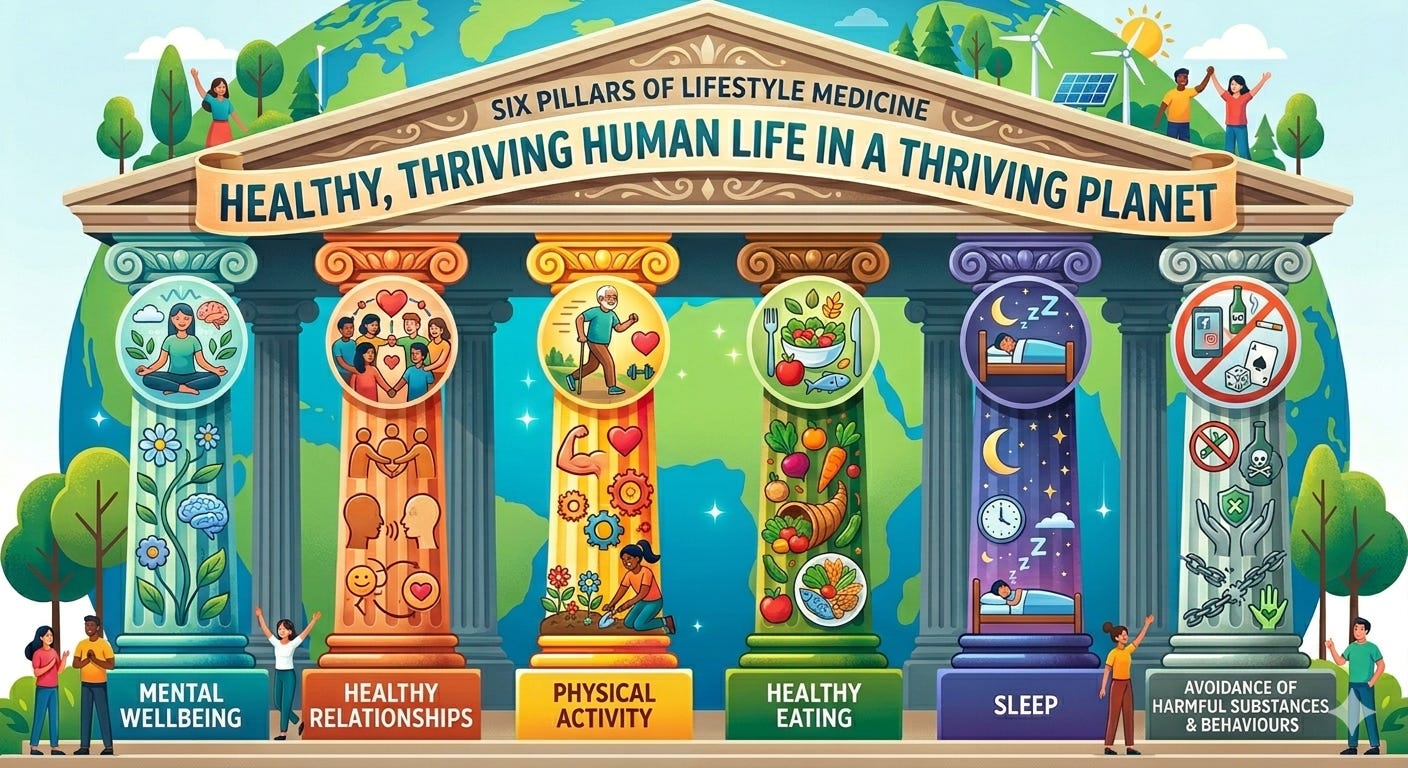
What is Lifestyle Medicine?
To paraphrase the American College of Lifestyle Medicine (ACLM): Lifestyle Medicine (LM) is a medical specialty that uses therapeutic lifestyle interventions to treat, prevent, and (where possible) reverse chronic conditions such as cardiovascular disease, type 2 diabetes, and obesity.
How it began
The philosophical foundations of Lifestyle Medicine go back at least two millennia, probably around the time Hippocrates famously said, “Let food be thy medicine and medicine be thy food.” His contemporary Galen of Pergamon prescribed specific exercises for specific health conditions. Many Greek-Roman writings of this time reflect the understanding that diet, exercise, rest, emotional state, and environment are the primary determinants of health and disease. In Asia - sometime before Hipocrates and Galen - Ayurveda was documenting the wisdom of dincharya (daily routine for health) and ahara (the link between nutrition and health), and Traditional Chinese Medicine (TCM) was emphasising the value of movement (through Qi Gong) and dietary balance (through Shi Liao).
The parallels across traditions are interesting: the Greek ideal of sophrosyne (“moderation in all things”) and the Ayurvedic dictum of ati sarvatra varjayet (“avoid excess in everything”) say essentially the same thing. The idea that how one lives determines one’s health was near-universal. And then we sort of forgot about it. The rise of germ theory in the 19th century and the pharmaceutical revolution of the 20th gradually displaced lifestyle-centered thinking from mainstream medicine, reducing it to background context against the powerful promise of drugs and surgery.
How it began, again (for the modern times, via modern methods)
LM began its comeback in the mid-20th century through two parallel developments: (a) the leading causes of death started to shift from infectious diseases to non-communicable diseases (NCDs) like diabetes and cardiovascular diseases; and (b) evidence that linked human behaviour to NCDs started to pile up. Landmark studies like the Framingham Heart Study (1948) and the Seven Countries Study (1958) were among the first to show the relationship between habits and disease. Further research made it clear that humans had vastly underestimated the toll that modern sedentary, processed-food-driven lifestyles were taking and that reversals were possible with data-backed behavioral changes. LM thus coalesced into a recognised, structured discipline based on the evidence that could no longer be ignored.
It’s all fairly new though. The American College of Lifestyle Medicine (ACLM), the first LM-focused professional medical association, was set up in 2004; the American Journal of Lifestyle Medicine (AJLM), the first LM-focused scientific journal was published in 2007. At this point, there are just over thirty national and regional Lifestyle Medicine societies. A recent entrant is the ISLM in India - a key geography for LM, not only because we are home to the largest population in the world, but also because we hold the dubious distinction of being the diabetes capital of the world. These national societies are linked through two umbrella bodies at the global level: the World Lifestyle Medicine Organisation (WLMO) and the Lifestyle Medicine Global Alliance (LMGA).
The six pillars of Lifestyle Medicine
Although the many LM-focused institutions in the world have evolved autonomously, they are in firm agreement about the six pillars that make the foundation of health: (1) Mental wellbeing, (2) Healthy relationships, (3) Physical activity, (4) Healthy eating, (5) Sleep, (6) Avoidance of harmful substances and behaviors.
It would be fair to observe that the Eastern traditions (Ayurveda, TCM, and probably others) never lost their lifestyle-medicine orientation in the way Western medicine did during the pharmaceutical revolution, only to rediscover it a century later. However, it is also worthwhile that with wisdom and means of modern times, we have built that much-cherished resource: evidence. Each of the six pillars has independent evidence on health linkages:
Mental wellbeing: Positive psychological well-being independently predicts lower all-cause mortality in both healthy and diseased populations
Healthy relationships: Strong social ties are associated with a ~50% increase in odds of survival over follow-up - an effect comparable to quitting smoking and larger than obesity
Physical activity: Structured exercise is at least as effective as pharmaceuticals in treatment for several chronic conditions like coronary heart disease and rehabilitation after stroke
Healthy eating: A Mediterranean dietary pattern reduces major cardiovascular events by roughly 30% in high-risk adults
Sleep: Both short (<7h) and long (>8–9h) sleep duration independently linked to all-cause mortality risk in a U-shaped curve
Avoidance of harmful substances: Lifelong smoking shortens life by about 10 years; quitting by age 40 recovers about 9 of those years
So what?
We know most of this already. Of course if we could all eat less, move more, sleep well and have healthy relationships, we’d be invincible. What is the big idea about creating a whole medical discipline about it?
LM is not just building the evidence for the value of lifestyle interventions; it is also building evidence for actionability. It acknowledges that giving people generic advice to “Eat less, move more” does not work. And therefore, it teaches clinicians the specific dose-response parameters that turn each pillar into a prescription. Physical activity comes with explicit targets based on meta-analyses. Dietary interventions are operationalised through scored, validated patterns (like the Mediterranean Diet Adherence Screener and the DASH score) rather than vague advice to “eat healthy.” Behaviour change itself is taught as a structured clinical skill which uses evidence-backed models of behavior change. The result is a structured clinical medicine rather than well-meaning wellness advice: a specific protocol, individualised to each patient, with measurable outcomes at each follow-up.
What is fascinating for me is that because many of these fields of expertise emerged during the lifetime of currently practising clinicians, this is not something they were actively taught during their training. I graduated from med school in 2004. While my textbooks certainly instructed me to “advise lifestyle improvements” to people with chronic diseases, it was as an adjunct to medical treatment, rather than as a possible, achievable, alternative. And there was no clarity on what that advice might look like. Even today, most formal medical training does not yet cover the science behind the impact of lifestyle factors on health and how to best support people with sustainable lifestyle change. But at the same time, there is an increasing recognition - both among patients and providers - that non-pharmacological-non-surgical treatment modalities are valuable and necessary.
And so, the doctors are learning. As of early 2026, about 10,000 clinicians from over 90 countries have earned Lifestyle Medicine certification from one of the four certifying institutions: the American Board of Lifestyle Medicine (ABLM), the International Board of Lifestyle Medicine (IBLM), the British Society of Lifestyle Medicine (BSLM), and the Australasian Society of Lifestyle Medicine (ASLM). This is the cohort of people leading the charge towards the creation of healthcare system where prevention and wellbeing receive as much attention as (if not more than) medical and surgical interventions.
When I started this course, I half-expected something closer to a self-help book in a white coat: well-meaning prescriptions to eat your greens and walk more. Instead, I’m two months in and learning to score Mediterranean diet adherence on a validated 14-item screener, to titrate exercise the way I’d titrate a statin, and to measure my patient’s loneliness on the UCLA scale before I measure her HbA1c. It is, unmistakably, medicine. What has surprised me more is that it is also the most patient-respecting medicine I have ever practised. More on that next week.
Next:
Part 2 (of 2): Five themes that define this science and underscore its value at this moment in history.
Comments
Post a Comment