One of the most interesting features of the human condition may be our ability to hold multiple, heterogenous identities. And it gets more interesting when the identities seem to contradict one another. I have a fairly large set of these personal identities which, at the surface level, seem to be at odds with one other and bring me varying degrees of entertainment. One of my least controversial (and getting more acceptable by the day) internal paradoxes is my relationship with traditional medicine: I trained to be a medical doctor under western medicine and I feel an irresistible tug towards traditional medicine, especially Ayurveda.
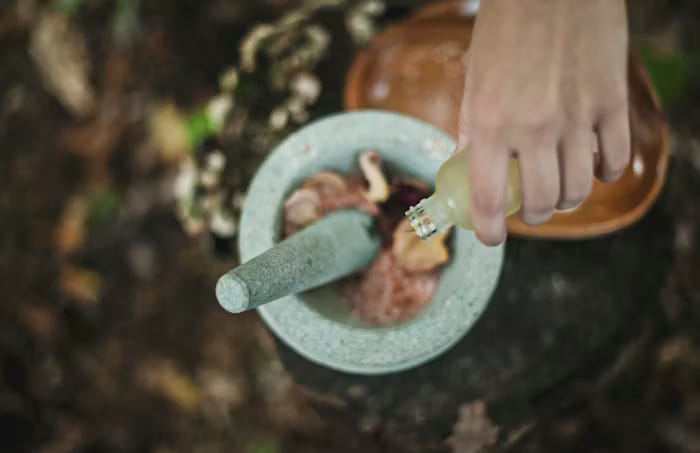
Photo by Katherine Hanlon on Unsplash
I started out with fairly uncomplicated, homogeneous ideas: I went to medical school, got an MBBS degree and held a small degree of skepticism towards traditional medicine. I learned and used the labels: pseudoscience, woo-woo, jholachhap medicine, unsafe. When I transitioned away from clinical work and into public health work, I found that the attitude of condescension towards traditional medicine is pervasive among global public health practitioners too. In my work as a public health specialist, I have examined ways to integrate traditional healers (also called informal providers) into the public health system, but primarily as people who would refer patients to the formal care system, not as partners in care.
But slowly, over the past few years, I have been changing my mind. There are two drivers of this shift, one internal, one external.
The external driver.
The first driver of my interest in traditional medicine is my observation that, for various reasons (but primarily capitalism), the way modern medicine is practiced is not the most human centric.
I feel the need to caveat this point. I went through the hoops myself. I have friends from med school who are literal pieces of my heart, whose lives and well-being are matters of importance to me. I know how hard a doctor’s life is. Every step is fraught with nerve-wracking experiences: getting into med school, then a master’s program, the decades of studying and getting bullied. And when you’re done studying, you’re just getting started - with struggle that is modern medical practice. It goes without saying that doctors care about their patients, but it’s also easy to understand the pressure to keep an eye on the margins. More the capital invested in infrastructure, more the pressure. Elements that are valuable to me as a patient are sources of inefficiencies in a modern hospital - choosing observation over intervention, responding to unending questions and doubts. And although we were taught that “health is a state of physical, mental, emotional and spiritual well-being and not merely an absence of disease”, when was the last time a doctor asked you about your social or spiritual life? It’s not a question of intent; they just don’t have the time.
Second, I have come to believe that traditional medicine’s model of care (gentle, approachable, ubiquitous) offers a possible solution to the severe GP (general practitioner) gap in healthcare. The world’s need for specialists is so great that the universe of family medicine practitioners and GPs has been shrinking. The OECD reports that in Australia, the UK and Denmark, the share of generalist medical practitioners decreased by more than 20% between 2000 and 20171. We don’t have data on India, but various experts have pointed to a “silent death of family medicine practice in the country”2. It is possible that this GP-gap is being filled by practitioners of traditional medicine. These doctors seem to have all the time in the world. They take detailed case histories (a friend recently shared that her history-taking process with a traditional medicine doctor lasted 3 hours). They are deeply interested in people’s social and emotional contexts, and they seem more open to being questioned and doubted.
So that’s the external driver of my interest in TM - that modern medicine can not and is not serving all the health needs of people, and that there is a clear need for the kind of intentional, holistic, slow-moving care that traditional medicine can provide. There’s also an internal driver to my growing interest in traditional medicine.
The internal driver, i.e. my intuitive self.
As I grow older, my intuitive self is becoming as powerful as my rational self, and they are rapidly becoming friends. I’m learning to rely on my body as much as I rely on my mind. Given that I have been inhabiting this body for over four decades, it feels logical that we have an intimate relationship which makes me the no. 1 authority on this body. Second, I’m the person who is most invested in the health outcomes of this body because I am the one who has to live with it for a few more decades. So I have both – the highest degree of expertise and the highest degree of investment. Ergo, the intuition that emerges from this body is as important as published science. Another personal observation is that the older I get, the happier I am. It is possible that this movement from living a purely logic-driven life to a life guided by intuition bodes for joy and well-being. And what does my intuitive self say? It says it trusts Ayurveda. It says that it is narrow minded to trust only a small set of “proven” things. It says that many of the things that seem “woo-woo” or magical today might just become proven science tomorrow, so keep an open mind.
I smell colonialization.
I hope we can appreciate the irony that the modern medical profession seems to be ruled by a near religious reverence for randomized control trials (RCTs). There’s a deeply held, passionately defended idea that the only real knowledge is the one that is read and written. RCTs are believed to be only way to establish evidence and efficacy; knowledge acquired through thousands of years of direct observation and introspection is deemed not merely inadequate or suspicious but potentially dangerous.
The large scale rejection of traditional medicine almost feels like a colonialization of healing. The power imbalance between Western and Eastern/traditional medicine has been systematically strengthened through labels - like “barefoot doctors” or “informal providers” - that effectively reduce trust. But like all colonial movements, this one is under threat too. It is no longer strategic or even possible for modern medicine to operate from a place of disdain towards traditional medicine. Public health and conventional medicine are losing the people who might have been helped if their questions and doubts had been treated with respect. Movements like MAHA and other anti-vaccine movements did not emerge from nothing. It is possible that they are a reaction (overreaction? maybe) to the authoritarian, “just trust me, don’t ask questions” attitude from modern medicine.
I feel hopeful.
At this point in my journey of curious exploration, I feel a mix of openness and hope. My current state of being is that of an adventurer, excited about a new landscape of learning. And just like any hero starting on a new journey, the universe has already started to help. I recently found and enrolled with an Ayurveda teacher who respects science and modern medicine, and yet, remains utterly, joyfully committed to the idea that the human experience is more than just the things that can be scientifically proven.
I see plenty of evidence that there is a growing cadre of modern doctors and public health specialists who find that traditional medicine makes sense – both to their logical and intuitive selves - and I am noticing an exciting trend of alignment between modern and traditional medicine. The alignment between these seemingly separate tracks is showing up in healthcare terminology: functional medicine, integrated medicine, holistic healing and most recent (and my favourite) - progressive medicine. My favourite podcaster and doctor, Rangan Chatterjee, believes that Ayurveda and traditional Chinese medicine are valuable partners in disease prevention and well-being. The WHO Global Traditional Medicine Centre hosted a Global Summit on Traditional Medicine earlier this month (December 2025). In an era of instability, the summit asked pertinent questions like: How can traditional medicine restore balance in an unstable world?
The science is evolving too; with every passing year, “woo-woo” advice from traditional medicine is not only being experimenting with but also being proven as accurate and relevant for modern times. Traditional medicine principles are undergoing RCTs and other types of evidence generation processes. This increasing body of evidence, and my own personal experiments and experiences are shaping the type of healthcare access I now dream of: hyper-personalized and whole-human centered (rather than disease-centered) care where people get to choose the care model that meets their preferences. Personally, I am excited about exploring these traditional sciences even for the areas where evidence does not exist (yet). A scientist who respects traditional medicine is not a paradox anymore; I am simply an open-minded pragmatist.
Sources:
OECD (2020), Realising the Potential of Primary Health Care, OECD Health Policy Studies, OECD Publishing, Paris, https://doi.org/10.1787/a92adee4-en.
Kumar R. The curious case of extinction of family physicians from the Indian Health System - An open letter to the members of the National Medical Commission: Draft competency-based medical education curriculum regulations 2023 - Complete exclusion of family physicians/family medicine education from the MBBS course curriculum! J Family Med Prim Care. 2023 Aug;12(8):1477-1484. doi: 10.4103/jfmpc.jfmpc_1323_23. Epub 2023 Aug 29. PMID: 37767427; PMCID: PMC10521820.
