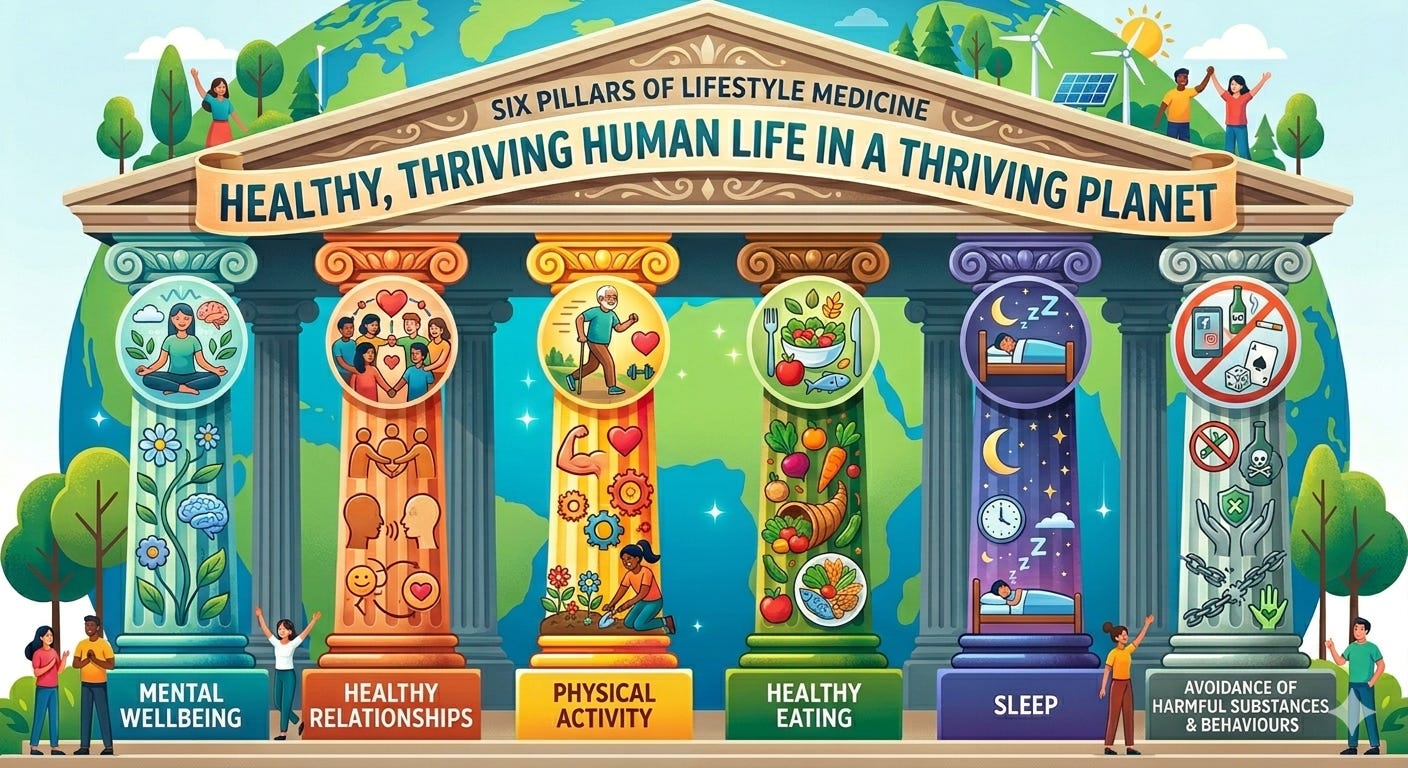
[I am a Lifestyle Medicine doctor (in-training). About a month ago, I submitted a (less opinionated) version of this piece as my Term 1 assignment for the year-long course I am doing with the Indian Society of Lifestyle Medicine (ISLM). ISLM has partnered with the British Society of Lifestyle Medicine (BSLM) to develop the course for Indian physicians. The views expressed here, although informed by my ISLM-BSLM curriculum, are my own.]
The Case for Lifestyle Medicine (LM)
As a new entrant to this community, I cannot help observing that Lifestyle Medicine physicians are simply a different kind of doctor. I find them sincere, kind, enthusiastic and mildly evangelical in their passionate desire to spread the understanding that good health is achievable through human effort. I am grateful for the series of chance encounters that brought me to this training, and I have embarked on this year long learning journey with the discipline and excitement it deserves.
Despite the many encouraging trends (a large and growing evidence base, thematic agreement across societies, surging physician interest), no country has yet formally recognised LM as a stand-alone postgraduate medical specialty. The UK currently comes closest: in 2024, the Royal College of General Practitioners (RCGP) established a recognised role: a GP with Extended Role in Lifestyle Medicine or a “GPwER-LM” (I bet these new GPs wished they had an easier name). Across UK, GPwER-LMs are leading dedicated lifestyle medicine clinics in primary or secondary care settings, heading multidisciplinary LM teams, and using lifestyle interventions specifically oriented toward treating (and in some cases reversing) type 2 diabetes, obesity, and metabolic liver disease. To my knowledge, this is the most significant step toward formal health-system integration that LM has achieved anywhere in the world.
The limited recognition is a mixed blessing. On the one hand, it makes the science accessible with minimal gatekeeping. On the other, it comes with limited regulation and oversight - which carries its own challenges, particularly when separating evidence-based practice from wellness marketing.
For me, five themes have emerged in the last two months of learning that define LM’s value in these complicated modern times.
1. Human behaviour >>> medical interventions
LM uses individual behaviour - rather than medical interventions - as the primary lever to manage health. As Dr Michael Greger puts it pithily in a BSLM course video, “exercise and nutrition are the penicillin of Lifestyle Medicine.” Each of the six pillars has independent evidence on health linkages. The LM ethos establishes that while medicines can treat conditions, behaviours can do more: treat the condition, treat underlying (or root) causes AND bring in additional whole-health benefits.
2. Evidence-based, but not at the cost of agility
The evidence-to-practice lag in conventional medicine is, on average, about seventeen years. Let me say this again: when scientists prove that some treatment modality works, it can take an average of 17 years for it to become part of global guidelines and recommendations. It can take longer for it to be taught in medical schools. For me, one of the most interesting examples of this knowledge-to-practice gap is the possibility of remission in type 2 diabetes (T2D). In 2011, the Counterpoint study first showed that T2D could be reversed through an 8-week very-low-calorie diet. Seven years later, the DiRECT Trial (Diabetes Remission Clinical Trial), published in The Lancet in 2018, confirmed this with a proper RCT which showed 46% of participants achieved remission at one year, 36% at two years. Hope was expressed that primary care physicians would use these findings to help people with T2D get off their medications. Is this taught in any medical school I know of? Nope. I asked around in my physician network, and the only doctor friend using this evidence with her patients is a family medicine practitioner who is also a trained Lifestyle Medicine doctor. “Deprescribing” - the opposite of prescribing, or the work of helping people taper off their medications - is now one of my favourite words, and one of my favourite lines of study.
Lifestyle Medicine teaches practitioners to use evidence-based strategies and also to evaluate and apply research more quickly. To do this, it uses something called the Hierarchies of Evidence Applied to Lifestyle Medicine (HEALM) framework, which says there are five types of evidence that, taken together, can build a credible case for any lifestyle intervention: randomised controlled trials (RCTs), prospective cohort studies, case-control studies, mechanistic research, and ecological or population-level data. The clever move is that HEALM doesn’t insist on RCTs as the sole gold standard: it accepts that for questions about lifetime effects of how we eat, move, sleep and relate, you often can’t run an RCT, and the honest thing to do is triangulate across different types of evidence. This dedication to agility and to using science faster is important because evidence is coming in thick and fast. I have to admit that even this framework is too strict and can be exclusionary towards other kinds of evidence like qualitative research, patient-reported outcomes, and the “long-but-less-scientifically” knowledge of traditional medical systems.
3. Human centricity
Conventional medicine can tend to be hierarchical: doctors hold more power than patients, and senior doctors hold more power than junior ones. At its worst, this manifests as violence against patients. Twenty years out of med school, I remain traumatised by what I have witnessed in labour wards, a phenomenon the global literature now formally names obstetric violence. At its most benign, the unequal power in the medical profession shows up in the excessive “sirs” and “ma’ams” still used in hospitals across South and Southeast Asia, long after these forms of address have been abandoned in other professional settings. And then there is the everyday friction of patients who arrive having googled their condition - a keenness to be prepared that some doctors (not all, to be fair) experience as a challenge to their expertise rather than as engagement with their own health.
LM, with its whole-person, behaviour-driven approach, upends this dynamic. The work of healing is done through the patient’s own actions - which makes the patient the entity with greater agency in the partnership. The doctor’s role shifts toward coach, partner, and evidence-translator rather than the authority figure who dare not be challenged. As someone long troubled by the power inequities in healthcare systems, I find a quiet poetic justice in this reversal. Perhaps this is why one of my textbooks describes Lifestyle Medicine as “as much an art as a science.”
It would be fair to wonder whether lifestyle medicine can potentially create new forms of paternalism. Lifestyle advice can easily slide into moralising, can place the burden of disease on individual choice and can be experienced by patients as judgmental (“you got diabetes because you ate badly”). Although we are taught to avoid this by paying attention to social determinants of health and by being intentional about shared-decision-making and behavioural coaching, it is an important red flag to watch for.
4. It’s what the people want
It won’t surprise anyone that “How to lower my blood pressure” is one of the most-googled health questions globally. Various studies have shown that one out five patients who are prescribed statins (the medicine to lower serum cholesterol) are unwilling to take the drug - not because they don’t believe that the drug works, but because of concerns around side effects. LM can empower people keen to take charge of their own health, with or without medication.
Another noteworthy societal trend is the growing scrutiny of capitalism, and the possibility that alternative economic systems are not just possible but perhaps urgently necessary; LM is one of the few medical fields that explicitly engages with the “commercial determinants of health” and acknowledges that there are many ways in which commercial interests are hurting wellbeing.
5. Alignment with the “Anthropocenic” challenges
As other climate-change-obsessed readers might know, Anthropocene is the name of the geological epoch we’re living in. It started sometime between the Industrial Revolution and the mid-20th century, and it is defined by the dominant presence and impact of human activity on Earth’s climate, ecosystems, and geology. There are four Anthropocene-era that challenges keep me awake at night, and LM speaks directly to each.
Ageing demographic. The factors that keep healthcare costs in check within a fast-expanding elderly demographic - staying mobile, eating well, sleeping well, staying socially connected - align neatly with LM’s six pillars.
Mental health. Roughly 1 in 7 humans now lives with a mental health disorder, and the need for mental health support is rising disproportionately faster than the available support. Lifestyle interventions offer a parallel, scalable, lower-cost adjunct to pharmacotherapy and psychotherapy. An RCT-backed dietary intervention (the SMILES trial) achieved depression remission in 32% of participants with moderate-to-severe depression versus 8% in controls.
Rising cost of healthcare. Non-communicable diseases (NCDs) - cardiovascular disease, cancers, diabetes, and chronic respiratory disease - account for about three-quarters of all deaths globally and are the biggest drivers of hospital admissions and healthcare spend. By tackling the modifiable risk factors that underlie these conditions, LM can meaningfully reduce healthcare costs. COVID-19 amply (and tragically) demonstrated the lifestyle–healthcare-cost linkage: people with poorly controlled cardiometabolic conditions had dramatically worse outcomes and accounted for a disproportionate share of hospitalisation costs.
Climate change. LM is planet-forward! It can impact one of the most influential climate change levers: transitioning toward plant-predominant diets can reduce diet-related greenhouse gas emissions by up to ~49% and freshwater use by up to ~21%. The same dietary patterns that lower cardiovascular risk also lower the carbon footprint of food.
Next:
I Ran 10K This Morning. I am still a “sedentary human”. (Why physical inactivity and sedentary behaviour are different things - and how both, independently, can shorten your life)